Readers of this blog might find an interesting contrast to the photos in David’s post from last week in the photos I’ve posted on my own blog. They’re panoramas shot at two of the same places pictured in David’s post, but during 2007 – the previous “wet year.” (Acutally, if memory serves, that winter and spring was wet but things dried out progressively after that.) They all show significant water flow, but nothing compared to David’s photos.
Monday, September 27, 2010


Friday, September 24, 2010
Tropical Storm Hermine
Here at Selah, the eastern edge of the Hill Country, tropical storms normally don’t bring us rain. Hermine, however, was a different story and it spent two days—September 7th and 8th—over us dropping ten and one half inches on these limestone hills. Selah is at the very top of a divide, the very highest point. We are downstream from no one. On the west, a big part of the watershed goes to the Blanco River and on the east it’s to the Pedernales … Because we have very good grass cover, the first two or three inches of rain is absorbed into the earth, replenishing our aquifer which keeps our springs, our sole source of water, producing … It takes up to seven hours, in a heavy rainfall, such as provided by Hermine, for runoff to occur at the lower elevations. You can actually see it coming and it rises very fast. Fortunately because the hills are steep, it generally goes down fairly fast. Not with Hermine however as you will see in the following pictures.

Madrone Lake is at a higher elevation so it was the first to fill up – and, as you can see, to overflow bringing tons of debris with it. This debris included a lot of Walnut, Pecan and Oak tree leaves whose tannin has left this normally crystal clear lake a light brown color. We don’t know when this will clear up. The spillway for the lake is 30 feet wide. Water flowed over it two foot deep. Photograph taken by J. David.

About one half mile below Madrone Lake is this dam on the Louis Bromfield Trail. There are stepping stones on top for you to walk across. I cannot recall in my 41 years here seeing this much water at this point on the ranch. Photograph taken by J. David.

Here we are at a still lower point at a low water crossing leading to the Aldo Leopold Trail. Water here was three foot deep. Photograph taken by J. David.

We recently took possession of thirty acres right at the entrance to the ranch. We’ve been using heavy equipment there, pushing cedar, cleaning up, moving earth so this scarifying of the land has left a lot of bare ground – not yet covered with grass. Just look at the amount of soil being carried away. Tons of it. It takes Mother Nature 500 years to replace this. Photograph taken by J. David.

Liquid Gold! – Notice how clear the runoff water is on this low water crossing at the Country Store. Well managed rangeland, land with good grass cover, land that’s not overgrazed, not only allows rainfall to soak into the earth, but also prevents the erosion of soil. Photograph taken by J.David.
RAINFALL - Last year, 2009 was a drought year even though we recorded 24.06 inches. What really affected us the most was 60 days of record 100+ degree days and only 1.11 inches in April, May, June and July. We sold half our cattle, lost over 2,000 trees, creeks dried up, stock tanks went to mud and spring flow fell below 1 gallon per minute. We were within weeks of having to buy drinking water.
Now we are at the end of September and with tropical storm Hermine’s generosity we have recorded 37.0 inches.
“THAT’S RANCHIN’!”
There are so many, many good causes that need financial help. Preserving the earth itself is important. So, if you would like to help us with a donation, we are a 501(c)(3) private operating foundation and gifts are deductible to the extent of the law. You can send your contributions to: Bamberger Ranch Preserve, 2341 Blue Ridge Drive, Johnson City, TX 78636 or donate through your computer by using PayPal.
Sunday, August 29, 2010
Like ’Em or Not – Lichens
This blog post has been on my mind for many months. Not that I studied it all that time, but mostly because it scared me! Not being a scientist I don’t speak genus and species, and really don’t know much about plants, etc. except the beauty and miracles I enjoy from them. So I asked Steven Fulton, our biologist, for help. “Steven, I want to do a blog on lichens and I need your help.” He asked, “When are you going to post it?” I said, “Next week” to which he replied, “I think you’ll need more time than that, there are 18,000 of them!”
In the winter of 2009 my friend, Joanna Rees, and I were exploring a very step rugged canyon on a part of the ranch named “High Lonesome.” We entered the canyon from the bottom climbing through thick brush, fallen trees, over rocks and stones. I was there primarily looking for any new source of water, a seep or spring, but we were also exploring, enjoying the Fall colors and getting good exercise. I hadn’t been in this canyon in years. It was thick with greenbriar which we were fighting and cutting on our way. At the head of the canyon rim it is lined with an outcropping of giant boulders, perhaps 20 feet tall. We could see where wild creatures had made their homes there. Perhaps coyotes, bobcats, maybe even our goats who are pastured there from time to time, but what got our attention were strange drawings on the face of these giant boulders. There were many of them and at first we thought – PETROGLYPHS. This was exciting as perhaps it would be another attraction for our education programs. We’re pretty excited about this and I can’t wait to show this to Steven. Upon looking at these interesting circles, Steven said these are not ancient Indian messages at all, but are in fact lichens. Not ancient, but they are formed over very long periods of time.
We have, over 40 years, been “building” a library here at the ranch. Not just field guides, but published research, and books on everything that exist with us and for us on this planet. Books on nature’s success stories, famous explorers who wrote about the Hill Country and modern day biologists and environmentalists. Books on endangered species and legal issues. Books on water, trees, grass, fossils – well you name it – we have a respectable library . . . but it had never occurred to me to acquire a book on lichens until my curiosity arose from the discovery of the “petroglyphs”!
I learned about the “lichen bible” as I call it – Lichens of North America by Irwin M. Brodd, Sylvia Duran Sharnoff and Stepehn Sharnoff published by Yale University Press. It’s unbelievably thorough and beautiful. It also is big and thick and it cost over $120.00! I also found in our library an article about lichens by Janet R. Edwards and printed in the Texas Co-op Power Magazine in September of 2001. I also got lichen information from my good friend Susan Sander, founder of the Riverside Nature Center in Kerrville. She is always full of nature knowledge. . . . One of the more unusual lichen things I received was through a Selah visitor, Gwendolyn Hallsmith, from Montpelier, Vermont. She, via email, introduced me to Alan Atkisson who wrote, among other things, “The Strangely Popular Lichen Song” which, with his permission, I’m adding the lyrics to this posting . . . You can buy the song on iTunes or on Amazon.com.
Now, just what are lichens? Once again, I have to confess – I’m not a biologist so I won’t try to get into the scientific lingo by copying from my Lichen bible – about the simplest way I can define a lichen is that they are small, colorful little creatures. They are not plants, but they grow or form just about everywhere in any environment from deserts to the Artic, on trees or stone, iron gates, power lines or dead wood. They are formed from a marriage of an alga and a fungus and like in any marriage (should be) they work together for the benefit of both. Lichens are different than mosses, fungi or algae, but I don’t have the ability to tell you about all their differences except that a mushroom is a fungus, mosses are small soft plants that, here on the ranch, grow on stones around our springs and as the adage goes “a rolling stone gathers no moss” and fungi are a group of spore-producing organisms feeding on organic matter such as molds, yeast, mushrooms and toadstools.
I read once in a government agriculture bulletin that it takes Mother Nature 500 years to manufacture soil. Well, it’s lichens that make this happen! One more fact before I move on, is that lichens are useful in making compounds used in medicines as well as herbicides, dyes and perfumes and if you’re poking around in bird nests, you’ll often find the birds used them in building the nests. So, you see, lichens are another of nature’s success stories!

Steven left me a post-a-note in the lichen bible instructing me to “find this in a tree.” It’s the 9 x 10 beautiful picture on the jacket cover of my lichen bible. I thought that should be so easy to spot until I walked trails and woods for two hours to no avail. You’d think an 82 year-old conservation oriented man like me would know better. When I complained to Steven, he reached to a branch over my head – he’s 6’8” - and broke off this dead branch. I had been wondering through the woods looking for a big patch of this orange beauty, not something the size of a nickel! Photograph taken by Lois Sturm.

Psora crenata (From the Lichen bible) Common name – Brickscale. Found on soil in arid sites. The scales are pink to pinkish-orange and turn grey-green when damp. They are very small. Photograph taken by J. David.

Here is Steven looking at the petroglyphs!! Well, not petroglyphs, but you can imagine how excited we were when we found them. The Lichen “bible” lists them as Speerchneidera euploca with a common name, Pale rockwood. Photograph taken by J. David.

Here you see a large group of the Pale rockwood. A common growth form of lichens is in circular patches or radial growth. Some lichens will maintain the entire patch of growth while others will allow the older center of the patch to become inactive and die leaving an outer ring of younger material which continues to take advantage of un-harvested nutrients/minerals from the substrate as it grows in a radial fashion. Photograph taken by J. David.

Dermatocarpon miniatum – common name Stippleback, leather lichen. Lichens have the ability to grow on rocks of all types and textures. These are usually found on limestone rock. Photograph taken by J. David.

The following are three pictures of lichen covered rock. Our hillsides on the ranch have many large rocks covered with the white patches – Hacma fenzlianum. We found very little of the yellow and orange. Photograph taken by J. David.

Photograph taken by J. David.

Photograph taken by J. David.
DISCLAIMER!!!!
Many times I’ve said I’m not a scientist. This is the most difficult blog I’ve ever tried and I might not have these lichens correctly identified. I will say I know much more now about lichens than I did before. Discovery and pictures were the easy part, the identification was not.
Now, if you want some real lichen entertainment fun, listen to Alan Atkinson sing his song. Here are the lyrics:
THE STRANGELY POPULAR LICHEN SONG
by Alan AtkissonOnce there was a fungus, Freddie was his name,
Said there’s no love for me among us
All these fungi look the same
So he took himself a’ courtin’
Down to where the green things grow
Met some algae name of Alice
She set his heart aglowCHORUS
Freddie Fungs, Alice Algae
Took a “Lichen” to each other
They grew so very close
That now you can’t tell one from t’other
Them lichens lead a simple life
They never are alone
Alice does the cookin’
And Freddie builds the home-That’s right, this song is biologically correct -
Well Freddie says, now Alice
You’ve made my life complete
But Alice said, “Now Freddie,
there’s something else we need.
gotta have some lichen children
little ones like you and me.”
So they broke up into pieces
That’s how lichens came to be.CHORUS
-That’s right, they’re domestic, but they’ve got a great love life – like you
Now you’re a lonesome fungus
And you’re hungry too, besides
Better hook up with somebody
Who can photosynthesize
And if you love each other
Like all good couples do
And take vows of symbiosis
You can be a lichen, too.CHORUS
There are so many, many good causes that need financial help. Preserving the earth itself is important. So, if you would like to help us with a donation, we are a 501(c)(3) private operating foundation and gifts are deductible to the extent of the law. You can send your contributions to: Bamberger Ranch Preserve, 2341 Blue Ridge Drive, Johnson City, TX 78636 or donate through your computer by using PayPal.
Sunday, August 8, 2010
Acquaintances Become Friends
Friend – “a person whom one knows well and is fond of; intimate associate; close acquaintance; applied loosely to any associate or acquaintance, or as a term of address even to a stranger” from Webster’s Unabridged Dictionary.
In Water From Stone, I’m quoted as saying that I know a lot of people, but I have few friends. However events in my life the past few years have lead me to questions my definition of friend.
As the dictionary says, it could be a close acquaintance. In going through this questioning, I’ve come to realize I have many friends so I retract my statement. I think Selah has done that for me . . . from the thousands of people, young and not so young, who have visited here my circle of acquaintances has evolved into friendships. Likewise, I have many of these visitors who tell me that the “Selah Moments” they have experienced here have had a profound life changing impact on them. They need to return to walk a trail, experience the changing seasons, see nature’s progress, to talk to Colleen, Steven or myself, to have another Selah Moment. These encounters over time, the familiarity from them that develops in our lives moves us from acquaintances to friends. One aspect of this that has moved me is that age, sex, religion, politics, social status, financial status, nor anything I can think of, none of these are a barrier to friendship. I’m so very pleased to have come to this realization. Reflecting on this has been a good experience for me. I recommend you try it.

Pilar and Apolos Urquieta live in Peru where they are restoring a tract of land and using it for environmental education. They learned about Selah from the internet. Photograph taken by Lois Sturm.

Kim Kennard spent three summers in Texas while doing research for her Master’s Degree in relation to bats and their value to agriculture. Kim did a short stint as an intern at Selah. Matt Valente is a Ph.D. candidate in Geography and Paleo Ecology. Photograph taken by Joanna Rees.

Ed Sones is a wildlife rehabilitator who has brought many “creatures” to the ranch for release. Here he is preparing a green heron for its new home on Selah. Grey and Willow Grote, who live here on the ranch, learn about the many animals brought here by Ed and Sallie Delahoussaye. Photograph taken by Lois Sturm.

Dr. Kunz has brought many scientists to Selah to do research on bats and along with others they have developed a system used to actually count the bats emerging from the cave. Pictured are some of the young people who spent three weeks with us in July. Their credentials are so impressive everything from undergraduate degrees, master degrees, doctorial degrees and post doc student except Lois and me who are “lowly” undergraduate degree holders. From left to right they are: Paul Heady, III, Winifred F. Frick holding their son, Darwin, Nathan Fuller, Lois Sturm, J. David, Dr. Tom Kunz, Jaclyn Aliperti, Leslie Pepin. Photograph taken by Mary Jo Snider.

Gary McCracken, Professor and Department Head Ecology and Evolutionary Biology, University of Tennessee. Gary is a nationally known bat biologist. He is a scientific advisor to our Preserve and was very helpful in 1997 when we built the Chiroptorium. Jennifer Krauel is a Ph.D. candidate at the University of Tennessee. Photograph taken by Joanna Rees.

Liz Braun de Torres, Ph. D. candidate Boston University does our bat censusing and three wonderful and interesting students who assistant her. They are from left to right Liz Braun de Torres; Luyi Zheng, graduate of Texas A&M at Galveston Marine Biology; Kristen Lear, Ohio Wesleyan University senior majoring in zoology; and Gary Kanner, Boston University Biology and Environmental Science. Photograph taken by Lois Sturm.

Most certainly my son, David K., and son-in-law, Ernie Sessums, would not fall under the definition of acquaintance! It is possible, however that, as we all grow a little older, sometimes moving far away making personal contact less frequent that in spite of the family link one may not think of a relative as a friend. This is not the case here as Ernie Sessums, left, and David K. Bamberger, right, are two of my best friends. Photograph taken by Joanna Rees.
There are so many, many good causes that need financial help. Preserving the earth itself is important. So, if you would like to help us with a donation, we are a 501(c)(3) private operating foundation and gifts are deductible to the extent of the law. You can send your contributions to: Bamberger Ranch Preserve, 2341 Blue Ridge Drive, Johnson City, TX 78636 or donate through your computer by using PayPal.
Sunday, July 25, 2010
Apple Pie and 4th of July
Oh how I remember those July 4th celebrations of the 1930’s and 40’s! I played trumpet in the marching band. As we played and paraded through that little village, there were American flags hanging everywhere, front porches were decorated with red, white and blue bunting, farmers came to our little town to witness the parade and the mayor, school superintendent or some official spoke to the crowd who gathered in the square. Those were the days my friends. Patriotism was supreme. As a young boy I thought only of the wonderful country I lived in, that my God was God and he was big and strong and protector of our country, our little town.
World War II broke out – the patriotism became even stronger. We had scrap drives, war bond rallies, more parades and flag waving. We also had rationing – rationing of sugar, gasoline, tires even toilet paper! There were only a small number of young men recruited into the military from my small community. Some never came home. My older brother was one of those – shot down over the English Channel. I remember quite clearly the day the news was delivered to my mother. Under these circumstances, it was a bit hard to wave the flag and boast of patriotism. There was however for my mother tremendous support from everyone in our little town. Patriotism prevailed and as a young man I was unaware of any divisiveness in our community.
So here at Selah I wanted to have an old fashioned 4th of July. From its establishment in 1969, Selah was to bring people from the left and right of environmental issues together . . . Unlike those years when I was a boy it seems to me that, as a society, we have too many divisive things taking place. Could Selah, in some small way, help to reverse this trend? So please enjoy our July 4th, 2010 celebration at Selah, Bamberger Ranch Preserve.

The patio at Madrone Lake was decorated with flags, stars, and bunting wrapped around trees. Everyone was invited to speak. I started off with my “Declaration of Dependence.” I declared my dependence on Mother Nature and the Planet Earth. A planet in trouble with signs of danger all around and we don’t seem as a world society able or willing to do the things necessary to protect our planet and thus ourselves from what’s going on. Photograph taken by Lois Sturm.

The spirit is in the air. Here Tom Kunz, our bat researcher from Boston University, takes the platform . . . The speakers are free to say anything they wish. Photograph taken by J. David.

John Phillips Sousa marching music reverberated across Madrone Lake and fifty people joined in to sing “God Bless America.” Photograph taken by Lois Sturm.

This was a Pot Luck Day with the ranch providing 60 halves of bar-b-que chicken. There was plenty of everything for all. Followed by four big, red, sweet and cold watermelons. That’s really 4th of July! Photograph taken by Lois Sturm.
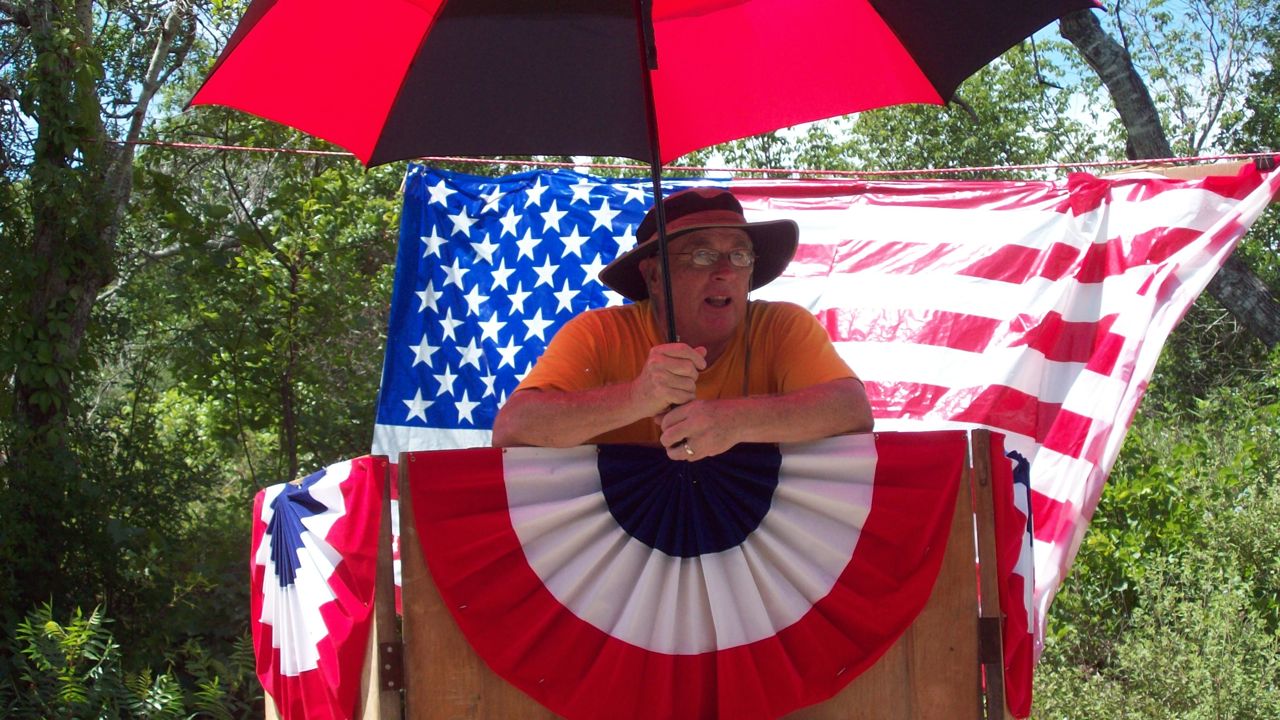
Bob Cowell, retired Air Force and now working for the Postal Service, took the podium and quickly drew the attention of the crowd with a stirring patriotic speech. Bob is a leader in the Bexar Grotto, a volunteer caver group that takes care of Bracken Cave. Photograph taken by J. David.

Winfred F. Frick, Post Doctoral Scholar, Center for Ecology and Conservation Biology, Boston University who now lives in California, got the spirit. “Fred” with her eight month old son, Darwin, enjoyed the day. Photograph taken by Lois Sturm.

Our celebration was really enlightening to these two men from Kazakhstan who are in the United States learning English at the Defense Language Institute at Lackland Air Force Base. My son, David K. Bamberger, serves as a volunteer under the “Amigo” program. Don’t you know what a celebration such as this would mean to them? Kazakhstan is at the belly of Russia. It has around 15 million population and is the 9th largest land mass country in the world. Photograph taken by Lois Sturm.

The lake was attractive to all the celebrants. Photograph taken by Lois Sturm.

Luyi Zheng was born in China before her parents emigrated from China. She is a graduate of Texas A&M University where she majored in Marine Biology. Luyi visits Selah once a month to assist Liz Braun who is censusing our bat colony using infrared computer technology. Photograph taken by J. David.

David K. Bamberger, my oldest son, gave a historical review of the 4th of July and its importance to all of us in protecting our values as a nation. Photograph taken by J. David.

Joann DeLuna is a long time volunteer at Bracken Cave and hard working member of the Bexar Grotto. Photograph taken by Lois Sturm.

For those who hadn’t been to Selah we toured the ranch for two hours on the BlueBonnet. It was a bit crowded, but the spirit of the day prevailed. Photograph taken by Lois Sturm.

It really wasn’t the crowded BlueBonnet that put “Bike Man” on his bike for the tour with us. He is just into biking. I really don’t know his name. Only know that he was on the ranch for two weeks assisting in some research using vertical profiler radar which was used to explore the behavior of bats, birds and insects in the lower atmosphere. Wow! Photograph taken by Lois Sturm.
There are many more photos of our “APPLE PIE AND 4TH OF JULY” celebration. I wish everyone could have been here. I particularly like the diversity of people. Not pictured are folks from England, Argentina and Canada who took the opportunity to speak . . . on our 4th of July patriotism was evident.
There are so many, many good causes that need financial help. Preserving the earth itself is important. So, if you would like to help us with a donation, we are a 501(c)(3) private operating foundation and gifts are deductible to the extent of the law. You can send your contributions to: Bamberger Ranch Preserve, 2341 Blue Ridge Drive, Johnson City, TX 78636.
Friday, July 9, 2010
Aeroecology – The Next Frontier
I’d make a bet that you who follow my blog have never seen this word. Neither had I, so I looked in my trusty Webster’s Unabridged Dictionary and wasn’t at all surprised that it wasn’t there! What was there was a number of words that will give you a clue – such as aerodynetics, “a branch of aviation that has to do with gliding” or aerodynamics “relating to the force of air in motion.”
Now – I’ll quote from a paper written by Boston University professor – Thomas Kunz, Ph.D:
“Every so often in the history of science and technology, empirical discoveries, theory, and technological developments converge, making it possible to recognize a new discipline. Past examples include astrobiology, biomechanics, sociobiolgy, and more recently, macroecology, bioinformatics, and nanotechnology – disciplines that are now well established in the lexicon of modern science and technology. Aeroecology is a new discipline of ecology that embraces and integrates the domains of atmospheric science, earth science, geography, ecology, computer science, computational biology, and engineering. The unifying concept that underlies this emerging discipline is its focus on the planetary boundary layer, or aerosphere, and the myriad of airborne organisms that, in large part, depend upon this environment for their existence. The term aerosphere is derived from the Greek aero, meaning air, and sphere referring to planet Earth. In contrast to continents and oceans, which are interrupted by one another, the aerosphere is the only environment in the biosphere that is truly circumglobal.”
So – What’s This Have To Do With Selah, Bamberger Ranch Preserve?
In past blogs, I reported that “research” was a part of our mission. But at the time we thought of this as being on plants, insects, birds and animals, the natural environment of the ranch. What’s going on here at our Preserve for three weeks in June/July is mind-boggling.

The researchers are funded by grant from the National Science Foundation and Air Force Office of Scientific Research, Boston University’s Undergraduate Research Opportunities Program, the Center for Ecology and Conservation, Biology, and a corporate donation from FLIR, Inc., the company that donated the mobile research laboratory for housing the high resolution thermal imaging cameras. This custom built trailer is used to transport the high tech equipment developed specifically for this research project. Photograph taken by J. David.

The object of the research is to learn how bats, birds and insects can fly in groups. You’ve probably noticed the ups and downs, the individual and group flight behavior of bats – more to our lifetime. Curiously, Roy Bedichek, author of Adventures with a Texas Naturalist, described these maneuvers as “a travesty of flight!” Photograph taken by J. David.

Nathan Fuller, graduate student, Ph.D. Program in Ecology, Behavior and Evolution, Department of Biology, Boston University, is holding a device used to calibrate three thermal infrared cameras for exploring and describing the movements of bats in three dimensions as they emerge from our Chiroptorium. Photograph taken by J. David.

These highly specialized cameras make it possible to characterize the flight of individual bats within groups (or so-called collective behavior) as they emerge nightly from the Chiroptorium. This research is being conducted by Professor Thomas Kunz, Director of the Center for Ecology and Conservation Biology, Boston University assisted by graduate students Nathan Fuller (Biology) and Diane Theriault (Computer Science), research assistant Jaclyn Aliperti (Biology), and undergraduate student Leslie Pepin (Biology). Photograph taken by J. David.

Trailer with a DeTect vertical profiler radar used to explore the behavior of bats, birds, and insects in the lower atmosphere. This equipment is being deployed as part of a “radar aeroecology workshop” being conducted here on Selah, Bamberger Ranch Preserve in early July. Photograph taken by Lois Sturm.

Paul A. Heady III, Research Technician, Central Coast Bat Research Group, Aptos, CA and his wife, Winifred E. Frick, Postdoctoral Scholar, Center for Ecology and Conservation Biology, Boston University along with the youngest scientist ever to be here doing bat research – their eight month old son, aptly named “Darwin.” Photograph taken by J. David.
There are another twelve scientists with us now. Too many to photograph. Besides, like bats they sleep all day and stay out all night!

I have seven copies of Dr. Kunz’s lecture, “Aeroecology: The Next Frontier” in a pamphlet form. It’s very interesting stuff. I will gladly send it to the first seven people who respond with your name and snail mail address.
There are so many, many good causes that need financial help. Preserving the earth itself is important. So, if you would like to help us with a donation, we are a 501(c)(3) private operating foundation and gifts are deductible to the extent of the law. You can send your contributions to: Bamberger Ranch Preserve, 2341 Blue Ridge Drive, Johnson City, TX 78636.
Monday, June 21, 2010
Building an Institution
Institution as defined in Webster’s Unabridged Dictionary – “an organization having a social, educational or religious purpose, as a school, church, hospital, etc.”
In modern day practice we think of an institution as some thing that’s been around a long time, such as a university, a museum, or perhaps even a restaurant. An institution also has to be recognized as delivering a dependable product or service and as a respected source of information.

We’re building an institution here at Selah. Although 41 years is not a long time, the ranch has been legally set aside in perpetuity for the natural world, education and research. Photograph taken by J. David.

Photograph taken by Margaret Bamberger.
Our Institution’s Goals
To maintain Selah, Bamberger Ranch Preserve in a natural state of grasslands and wooded canyons, which provide healthy habitat for native and endangered species as well as domestic plants and animals, and to protect it from development.
To demonstrate through a working example of grass-based agriculture the practices of good conservation and their value to the entire ecosystem.
To educate visitors by providing facilities and programs which enhance the visitor’s experience and encourage appreciation and awareness of Selah’s and their own natural and cultural heritages.
To provide a place where visitors of all ages can experience the beauty of nature, learn the importance of good conservation and land stewardship, and leave with a sense of power that the individual can positively impact his or her environment.
To manage the resources and facilities of Selah in such a way that agriculture, education, recreation, and “People ranching” will come as close as possible to meeting its costs of operation while preserving it for future generations of people, plants and animals.

Statement of Philosophy
We honor and respect the natural world and its biological heritage.
We recognize that good stewardship maintains a diversity of healthy habitats, and therefore the diversity of plants and animals that are able to exist in them.
Good land management provides clean water in greater amounts than in poorly managed land. In the Hill Country’s climate and type of land it is extremely important to maximize water conservation (both surface and underground), because with population growth we experience increasing demand on limited resources.
Integrating human needs into the natural world involves:
- teaching the public about the importance of good stewardship,
- providing a place to experience the importance of good stewardship,
- teaching conservation of resources,
- and instilling a love and appreciation of the natural world in children and adults so that the desire abundant healthy water, land and habitats around them.

Mission Statement
The mission of the Bamberger Ranch Preserve is to protect the 5,500 acres of land, keep it in good health and balance, and educate the public about stewardship of the land, as well as awakening and nourishing a passion for learning about nature in both children and adults.

Here at Selah we spend so much time “people ranching” - (that’s the education part of our mission) – that the true ranching activities of Selah are overlooked. . . . We believe that a well-managed ranch can have cattle, horses, sheep and or goats and still be a protector of all species, large and small, flora or fauna.

Photograph by J. David.

Photograph by J. David.

Photograph by J. David.
Because of a nice cold winter with good rains we were able to harvest surplus grass . . . hay . . . It’s been a few years since this was possible. This harvest has always been among my favorite times. To walk the field behind the hay baler as the evening sun goes down, picking up the bales and taking them to the barn. There’s a nostalgia to this. I’m too old now to do the lifting, but I can walk, see and smell and enjoy this harvest that some call work!
If you believe as I do that all of the things I’ve talked about on this and past blogs are important for the future health of our nation won’t you please help us build this institution?
There are so many, many good causes that need financial help. Preserving the earth itself is important. So, if you would like to help us with a donation, we are a 501(c)(3) private operating foundation and gifts are deductible to the extent of the law. You can send your contributions to: Bamberger Ranch Preserve, 2341 Blue Ridge Drive, Johnson City, TX 78636.
Subscribe to:
Posts (Atom)