Showing posts with label grasses. Show all posts

Friday, May 13, 2011

Grasses, Politics and Education

Our current State Legislature is considering a bill to allow ranchers to retain their agricultural exemption if they maintain a healthy grass cover on their rangeland. Why would this be good for the people? It’s really quite simple. Range grasses prevent runoff of precious soil. They allow rainfall to percolate into the earth refilling our underground aquifers. Grasses filter out harmful chemicals such as pesticides, fertilizers and herbicides making water pure and less expensive to our homes . . . . Grass is the cheapest, fastest and most efficient conservation practice there is and that’s why I support this bill.

I was asked to testify before a Senate Committee on Senate Bill 449 authored by Senator Kirk Watson. The hearing was on March 26, 2011. I thought it would be a real eye opener if the committee could see what a totally unseen part of grass is like. Joanna Rees and I spent the better half of the previous day digging deep into the earth to get the roots of grass. We dug up three species – Little Bluestem, Indian Grass and Lindheimer Muhly, each having differing root systems. I’ve been told there is a government bulletin that states that in one square yard of a prairie the roots would be 9 miles long! Going through security at the Capital I was asked what I had in the bag. When I said, “GRASS,” they said, “NOT THE SMOKING KIND!!!” They are not used to this sort of show taking place in the Capital! Photograph taken by Joanna Rees.


Unfortunately, the Senators didn’t allow me enough time to really extol the many virtues of grass. The hearing room was crowded, standing room only. The timing light came on and the buzzer rang. The Chairman spoke through the microphone, “Mr. Bamberger, your time is up”, but I protested and continued. By this time I had the grasses out and dirt was falling all over the table. At this point the chairman interrupted my testimony, “Are we to understand, Mr. Bamberger, that grasses are important for the conservation of water?” to which I replied, “You’ve got it!” The crowded hearing room loved the performance and gave me a strong ovation. Photograph taken by Joanna Rees.

The following day I had the opportunity to use the grasses again. This was at the Thompson Conference Center on the UT campus where we were giving our conservation experience to a continuing education group for Seniors known as Quest. 50 of the members had visited Selah a few weeks prior to this day. Photograph taken by Joanna Rees.

The goal of the Quest Program is to provide those who participate with continuing intellectual growth in a campus environment. The Thompson Center is one of my very favorite places to speak. It is equipped with the very latest technology and young people there to help with its operations. Photograph taken by Joanna Rees.

Another opportunity to use the grasses came up on March 29, 2011 when Andy Sansom, Executive Director of The River City Institute and Research Professor of Geography at Texas State University at San Marcos, invited me to speak to his class which also included continuing education adults from the community. Andy is one who really knows, appreciates and teaches the value to society of grasses. Photograph taken by Joanna Rees.

I shared the evening with Matt & Peggy Winkler. The Winklers have 1800 acres on the Pedernales upon which they have cleared much of the cedar and established good grass cover. Actions like this stabilize river banks and allow the Pedernales to flow clear clean water. The Winklers have also made a gift to society by placing a conservation easement on their ranch, thus protecting it from development in perpetuity. Photograph taken by Joanna Rees.

It was 1959 when I bought my first ranch, 205 acres just twenty miles north of San Antonio. At that time, there were very few universities that offered classes on the environment. Conservation didn’t seem to be of much concern. Now, thanks to a great awakening college classes are full of young people anxious to learn and to apply that learning to solving America’s many environmental problems. I’m so glad that Selah, not just me, but all of us that live here, can by our example play a role in this learning process. Photograph taken by Joanna Rees.


Here at Selah’s 5500 acres we not only operate a working ranch with cattle, goats, hunting and hay making, but also we share the ranch with thousands of young people and adults through our many education programs and our outreach programs such as this blog on grasses . . . . But here’s where we are so very, very different. We do all of this with just five employees and some volunteers . . . . It’s been ten weeks since I’ve written my blog and that’s because we need help, but that takes money. I invite you to come here and experience this place and its people before making a commitment. This place is different. You will find no gift shops, vending machines or cafés. It’s all preserved for nature, pure and simple and that’s worth saving. We are a 501c3 private operating foundation. We have an outside Board of Directors and contributions are deductible to the extent of the law. Please call us at 830-868-2630.

Sunday, October 18, 2009

People Ranching

It was in the early 1990’s while a member of Governor Richards’ task force on nature tourism that someone first spoke the words “People Ranching.” So it’s really not original with me, but we are the ones who have popularized it. Think about this ~ in early history, ranching meant raising cattle, sheep or goats. After World War II hunting was added to what ranchers did to help support themselves and this was a departure from tradition as it involved strangers being on the ranch. The addition of exotic animals and high fences meant more income, but of course more people. This was hard to accept by some of the “old timers” but generational changes, the need for income and a new breed of landowners saw the changes coming. The reality was that the economics of traditional ranching no longer made sense. It is my contention that you cannot buy any ranchland anywhere in the state of Texas and pay for it with any form of agricultural production. Why? Because land prices are now dictated by high income people who want the quality of life offered by rural land or the price is dictated by the population growth to whom the developer caters.


Now a new ethic is developing – that being an interest in preservation, conservation and species survival. So here on Selah we invited people, young and old to come, to see and to learn from our experience. We built infrastructure and developed programs and because of this new ethic people came and thus “People Ranching” became a real thing. I understand that the term has now entered college textbooks.


Each Spring and Fall we hold a series of workshops for new landowners, agency people, teachers or anyone interested in the topic. On October 10 a one day workshop affair titled “Grasses” was attended by 22.


Our Grass trail didn’t do well this year because of the very severe drought and record high temperatures. So Steven Fulton, Ranch Biologist, propagated and nurtured 30 species in containers. Photograph taken by J. David.


The containerized grasses enable everyone to see the grasses up close and some in a mature state. Each container is labeled. Here Steven is explaining details, the nomenclature of the plants. Photograph taken by Colleen Gardner.


Colleen Gardner, Executive Director, with two of the “students.” Everyone on the staff participates in all of our workshops. Photograph taken by J. David.


Ann Baird, who deserves a Ph. D., as she has taken four of our workshops. Justin Duke, Ranch Steward, is describing Big Bluestem. Photograph taken by Colleen Gardner.


This is were it all happens! Out on the ranch. We don’t spend any time looking at videos or virtual grasses. Photograph taken by Colleen Gardner.


Steven and Justin are with the “students” at all times. This is true in all our workshops. Photograph taken by Colleen Gardner.


There’s a coffee and restroom break at the Country Store at each workshop. Photograph taken by J. David.


By mid morning we find high spirits and bonding by the “students.” Photograph taken by J. David.


Check this blog next week for more on People Ranching.

Saturday, December 1, 2007

Welcome to the Bamberger Ranch Journal


Corey, the dog, fishing in Madrone Lake. ©2007 Margaret Bamberger
Field and woods. ©2007 Margaret Bamberger
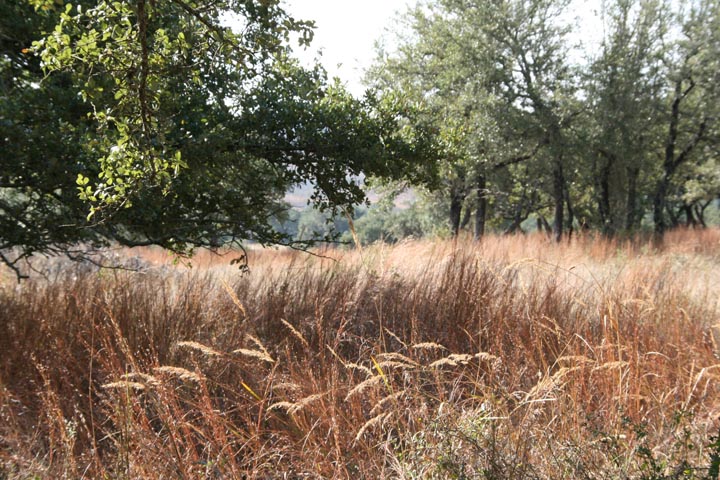
Grasses, including yellow indian-grass and little bluestem, with live oaks. ©2007 Margaret Bamberger

Hello friends (new and old) and Welcome to the Bamberger Ranch (Preserve) Journal (blog).

I plan to post frequent blogs (I'll try for once a week) with narratives and pictures of interesting things happening here, primarily in the natural world, but also about people and events.

A Little Background About Bamberger Ranch Preserve (BRP)


The BRP is a 5500 acre ranch that is in a 501-C-3, non-profit foundation with a board of directors, educational staff, and a ranch operations manager. A small portion of the ranch is not yet in the foundation, so that it's founders, J David Bamberger and his wife, (me) Margaret can live here for now. When we are both gone the house and its surroundings will be added to the Preserve.

At the ranch we have domestic animals (cows & goats), educational programs, and Stewardship workshops (see our website for more about these: www.bambergerranch.org). We also have a herd of Scimitar Horned Oryx which are no longer found in the wild in its homeland of Africa and is being protected and managed as part of an SSP (Species Survival Program). We built a man made bat cave, called a Chiroptorium, which is home to 120,000 Mexican free-tailed bats from March to October. Several endangered birds live and nest here also, the Golden-cheeked Warbler, and the Black-capped Vireo. A total of 202 species of birds have been documented as being seen here.

Recently


The grasses are more beautiful then I have ever seen them before. During the abundant spring and early summer rains they grew to unusually large sizes, and the individual bunch grasses such as the bluestems and the muhlys increased in width. Then as fall arrived they turned fabulous colors. The bluestems turn shades of rusty red, yellow indiangrass a fine deep gold, and some others a straw yellow. The combination of height, thickness and color have made the last month stunning.

Today I noticed that in the last four days the colors of the trees have changed dramatically and the reds and oranges have developed and are bright and beautiful. 

This is the first time I've tried to write a blog.  I look forward to learning more about how to get pictures to go where I want them, and expect that after a while I'll find the process much easier than I do now.  So until next week, goodbye -and don't forget to take time to enjoy the natural world.

Photographs:  1-  Madrone Lake in late summer this year.  Note that Cory our dog is engaged in his favorite summer activity, fishing.  He watches the fish in the water, and jumps when he thinks he can catch one - so far he hasn't succeeded. 2- Looking down from a hill-top to a scene below to a field and the woods in the background. (Taken several weeks ago.) 3- Grasses, including yellow indian-grass and little bluestem, with live oaks. (Taken last Tuesday).