In the past, groups requesting tours of the ranch have sometimes contacted Margart Bamberger directly. Instead, we'd now like those requests to be directed to Colleen Gardner, whose email address is: brp(at)tstar(dot)net. Thanks, and enjoy the tours.
Showing posts with label ranch info. Show all posts
Showing posts with label ranch info. Show all posts
Tuesday, February 24, 2009


Sunday, December 9, 2007
Fall colors and beginning of winter

In November we had some cool days and nights, as well as some drizzle and fog. In the picture above there is rusty-red little bluestem grasses, a Texas oak turning red, and in the background, hills shrouded in fog.
It in now the second week of December, and we have had a couple of windy days so most of the leaves are down, and winter's colors dominate the wooded areas of the ranch. There are many areas in which Live oak is the dominant tree, and of course they are green all winter. The grasses are still beautiful, but their colors are not as intense as they were in October and November.
Not remembering the exact reasons for the fall color changes in tree leaves, I pulled out my botany text book to refresh my memory. I found a web site that gave me even more information about fall colors: Why Leaves Change Color. The three main factors that influence the color changes are pigments, length of night and weather. The colors of a particular species of plant in fall is a combination of its heritage and weather conditions.

The pigments in leaves are chlorophyll, carotenoids, and anthocyanins. Chlorophyll is the green pigment that is necessary for photosynthesis (making sugar from CO₂ and water using sunlight) and are found in chloroplasts of leaf cells. Carotenoids produce yellow, orange and brown colors in fruits and vegetables as well as in leaves, and anthocyanins give color to fruits such as cranberries, red apples, blueberries, strawberrries, and plums. Chlorophyll and carotenoids are found in chloroplasts throughout the growing season. When chlorophyll fades out as nights get long and temperatures go down, carotenoids get a chance to shine. Most anthocyanins, which are present in the watery liquid of plant cells are produced in fall in response to light and excess sugars that are trapped in leaves when the flow of fluids is cut off by the accumulation of cells at the base of the stem holding leaves to twigs. They too can be seen when green chlorophyll is no longer produced. That layer of cells I mentioned at the base of the leaf stem eventually cuts off all flow of water and nutrients between leaves and the rest of the plant, and the leaf falls off.
Enough of the science of color changes. This year there were some beautiful yellow, orange and red Big-tooth maples.


Some plants turn an intense red, and have names that indicate its consistent color, such as Flame-leaf sumac.

Many, but not all, of the Texas oaks turned orange or red. Some just turned brown before dropping their leaves. This one was a beautiful scarlet.

Bald cypress turn a rusty brown before their needles fall down. How long they hang onto their needles depends on weather and wind, and this year they fell down fast. Needles float in the water, and sometimes one can see beautiful images when looking down into the water underneath a cypress. In this picture we can see needles floating, green water plants in clear water, and cypress branches outlines by intense blue sky.

I'll miss the beautiful colors of fall, but there is beauty in winter. I love the shades of grey that are seen in the bare trees. Also, tree shapes are fascinating, and I've learned to recognize many different trees by their shape, and arrangement of limbs.
It is Sunday evening, and a cold front has just arrived. Rain is in the forecast, and we really need it. Stay warm, but enjoy the outdoors.
Saturday, December 1, 2007
Welcome to the Bamberger Ranch Journal


Hello friends (new and old) and Welcome to the Bamberger Ranch (Preserve) Journal (blog).
I plan to post frequent blogs (I'll try for once a week) with narratives and pictures of interesting things happening here, primarily in the natural world, but also about people and events.
A Little Background About Bamberger Ranch Preserve (BRP)
The BRP is a 5500 acre ranch that is in a 501-C-3, non-profit foundation with a board of directors, educational staff, and a ranch operations manager. A small portion of the ranch is not yet in the foundation, so that it's founders, J David Bamberger and his wife, (me) Margaret can live here for now. When we are both gone the house and its surroundings will be added to the Preserve.
At the ranch we have domestic animals (cows & goats), educational programs, and Stewardship workshops (see our website for more about these: www.bambergerranch.org). We also have a herd of Scimitar Horned Oryx which are no longer found in the wild in its homeland of Africa and is being protected and managed as part of an SSP (Species Survival Program). We built a man made bat cave, called a Chiroptorium, which is home to 120,000 Mexican free-tailed bats from March to October. Several endangered birds live and nest here also, the Golden-cheeked Warbler, and the Black-capped Vireo. A total of 202 species of birds have been documented as being seen here.
Recently
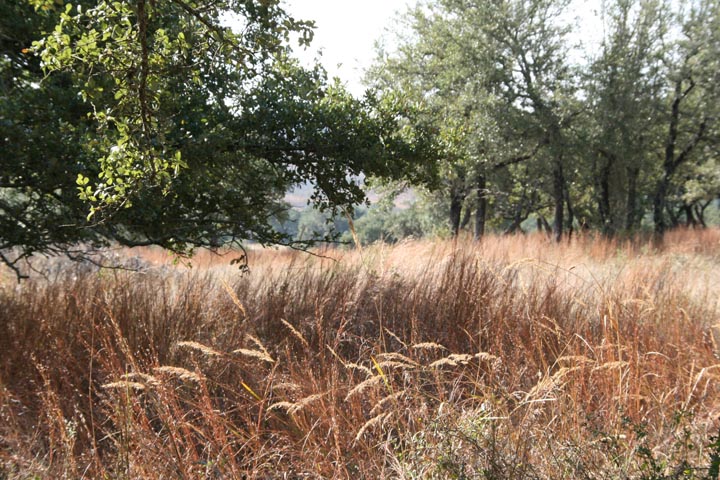
The grasses are more beautiful then I have ever seen them before. During the abundant spring and early summer rains they grew to unusually large sizes, and the individual bunch grasses such as the bluestems and the muhlys increased in width. Then as fall arrived they turned fabulous colors. The bluestems turn shades of rusty red, yellow indiangrass a fine deep gold, and some others a straw yellow. The combination of height, thickness and color have made the last month stunning.
Today I noticed that in the last four days the colors of the trees have changed dramatically and the reds and oranges have developed and are bright and beautiful.
This is the first time I've tried to write a blog. I look forward to learning more about how to get pictures to go where I want them, and expect that after a while I'll find the process much easier than I do now. So until next week, goodbye -and don't forget to take time to enjoy the natural world.
Photographs: 1- Madrone Lake in late summer this year. Note that Cory our dog is engaged in his favorite summer activity, fishing. He watches the fish in the water, and jumps when he thinks he can catch one - so far he hasn't succeeded. 2- Looking down from a hill-top to a scene below to a field and the woods in the background. (Taken several weeks ago.) 3- Grasses, including yellow indian-grass and little bluestem, with live oaks. (Taken last Tuesday).
Subscribe to:
Posts (Atom)